

DSP/100 · March 14, 2026 · Dealer News · 10 min
The Difference Between a GPT Wrapper and a True Agentic Dealership CRM
By Nick Askew

A lot of “AI-powered CRM” products in automotive are really just language models wrapped around messaging. They help write texts, summarize calls, generate notes, or suggest follow-up copy. That is useful, but it is not the same thing as a true agentic CRM.
A true dealership CRM with AI should not stop at writing. It should understand customer context, decide the next best action, use tools inside the workflow, update records, assign work, and verify that the action actually happened. Google Cloud’s documentation defines AI agents as systems that reason with tools and take actions to achieve a goal, and it specifically notes that simpler tasks like summarization do not necessarily need agentic workflows.
That difference matters in automotive because the problem is rarely “we needed better wording.” The problem is usually “the shopper moved, and the system didn’t.”
Why this distinction matters more in automotive than almost anywhere else
A dealership sale is not a single conversation. It is a chain of events across inventory pages, trade valuation, payment exploration, credit, document collection, calls, texts, appointments, desking, showroom handoff, and manager visibility. When those moments do not stay connected, the customer feels friction and the store loses momentum.
Cox Automotive’s latest Car Buyer Journey findings make the market direction clear. In its January 2026 release, Cox said record satisfaction was being driven by efficiency, digital tools, AI, and seamless omnichannel retail. In that same study, 63% of shoppers said the ideal buying experience combines online and in-person activity, while only 7% completed the whole purchase entirely online. Cox also found meaningful gaps between what buyers want to do online and what they actually can do: 48% wanted to apply for credit online but only 33% did, 40% wanted to select F&I products online but only 16% did, and 37% wanted to finalize price online but only 19% did.
That is the real job of an automotive CRM with AI: not to impress a buyer with a polished reply, but to preserve continuity across the whole deal.
What most AI-powered CRMs in automotive actually do
To be fair, a so-called GPT wrapper is not worthless. It can absolutely save time.
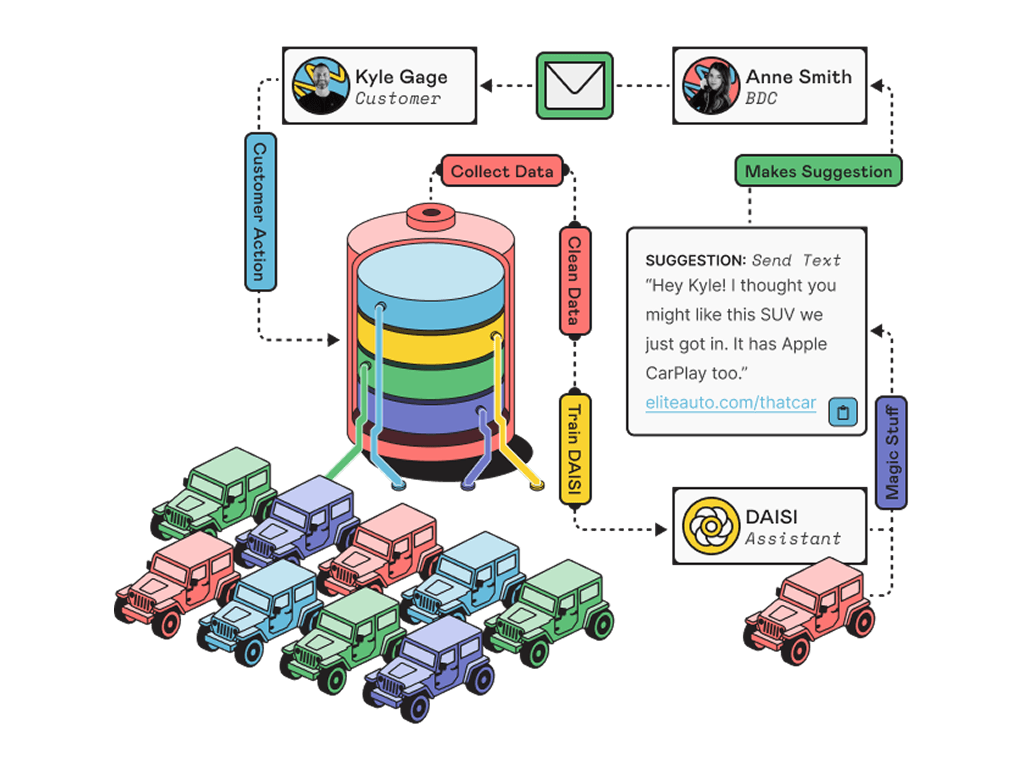
In one of the best-known studies on generative AI at work, NBER reported that customer support agents using an AI conversational assistant saw productivity increase by nearly 14% on average, with gains of roughly 35% for lower-skilled and less experienced workers. That is a real result. Assistive AI can help teams answer faster, write cleaner messages, and standardize communication.
But that same result also reveals the limitation. Message assistance improves one step inside the process. It does not fix the process itself.
A wrapper-style AI CRM usually does one or more of these things:
drafts emails and texts
summarizes phone calls
creates suggested notes
recommends follow-up language
maybe scores or categorizes leads
That is still an assistant layer. It helps a human do the work. It does not actually move the workflow on its own.
In a dealership, that means the AI might generate a smart-looking follow-up, but still fail to:
book the appointment,
assign the salesperson,
resend the right credit link,
tag the right manager,
update the deal stage,
label the customer correctly,
or know whether the shopper completed the next step.
That is not execution. That is copy support.

What a true agentic CRM does differently
A true AI dealership CRM is stateful, tool-connected, and outcome-oriented.
Google Cloud’s architecture guidance is blunt about what makes an agent different: agents are valuable when work involves autonomous decision-making, real-time use of external data, complex multi-step workflow management, tools, memory, and execution. In other words, agents create more business value when the job is not just “generate text,” but “understand the goal, plan the sequence, and complete the work.”
That is why the difference between an AI-powered CRM and a true agentic CRM comes down to five things:
1. Shared context
The AI sees more than the last message. It sees website behavior, inventory viewed, digital retail progress, credit status, document state, communication history, and deal ownership.
2. Memory and state
It remembers where the customer actually is. Not just who they are, but what they completed, what they abandoned, what was promised, and what still needs to happen.
3. Tool use
It can do things inside the dealership system. It is not limited to talking about the work. It can create the task, assign the rep, update the CRM, send the right link, confirm the appointment, and log the result. Google Cloud specifically describes tools as the bridge that turns an AI system from a text generator into a system that automates complex, multi-step tasks.
4. Closed-loop execution
It does not stop after one message. It checks whether the customer finished the step. If not, it chooses the next move inside guardrails.
5. Human control
The best agentic CRM is not reckless automation. It gives the dealership clear permissions, escalations, visibility, and override points.
This is the difference between AI that sounds useful and AI that behaves like infrastructure.
In a dealership, speed matters. But continuity matters even more.
Lead response is one of the clearest examples.
The MIT/InsideSales Lead Response Management study found that the odds of qualifying a lead decrease more than sixfold in the first hour. It also found that the odds of qualifying a lead when called in 5 minutes versus 30 minutes drop 21 times. Those numbers are old, but the core lesson is still brutal: the window closes fast.
Now apply that to automotive reality.
A shopper lands on a VDP at 10:12 p.m., works a payment, starts a credit app, gets halfway through, and stops.
A wrapper CRM sends:
“Hey, just checking in to see if you need anything.”
A true agentic CRM for automotive can do something far more valuable:
identify the exact step where the shopper stalled,
resend the correct credit continuation link,
create a morning follow-up task for the assigned rep,
flag the lead as high intent,
log the abandoned state,
send a confirmation when the customer resumes,
and escalate if an appointment becomes the better next move.
That is what dealerships are actually buying when they search for dealership CRM with AI. Not better prose. Better execution.
The efficiency truth: assistive AI helps one person, agentic AI helps the whole store
This is where a lot of automotive CRM marketing gets fuzzy.
Assistive AI improves local productivity. It makes one employee faster at one task. That matters, and it is worth having. The NBER evidence supports that.
But agentic AI improves system throughput.
It reduces:
response lag,
dropped handoffs,
duplicate entry,
forgotten follow-up,
stale lead ownership,
appointment leakage,
and the dead space between online intent and in-store action.
Cox Automotive’s 2024 Power of Data study found that dealers know data has value, but many still struggle to extract actionable insights from it. The same study also found that dealers using their data most heavily report a stronger positive impact on business results. That is the strategic argument for a true AI automotive CRM: the win is not “we collected more data.” The win is “the system turned live context into the next right action.”
Why Space Auto’s position is different
Space Auto’s view is that AI should not sit on top of the CRM like a smarter chatbot. It should live inside the CRM as part of the operating system.
That is why the Space Auto model is not just “AI-powered follow-up.” It is a network of embedded agents inside the dealership workflow: autoresponder, follow-up, tasks, labels, appointments, monitor, and admin. The point is not to create impressive demo copy. The point is to let the system observe customer intent, decide what should happen next, and carry out that action inside dealership guardrails.
That architecture matters because the dealership workflow is operational, not purely conversational.
A shopper does not just need an answer. They need the deal to keep moving.
If a customer says on a phone call, “I’ll be there at 10:30 tomorrow,” a wrapper gives you a summary. An agentic CRM should be able to book the appointment, assign the salesperson, notify the manager, write the note, and preserve the timeline.
If a customer submits a trade and changes their down payment online, a wrapper can mention it. An agentic CRM should update the customer profile, surface the change for the desk, and tee up the next best action.
That is a completely different category of value.
Buyers are getting more comfortable with AI. Dealers need to get more serious about architecture.
Cox’s 2025 Car Buyer Journey study found that 25% of new-vehicle buyers used AI tools during shopping, and 83% of consumers said AI will affect the way vehicles are purchased in the future. Among mostly digital buyers who used AI tools, 84% reported high satisfaction with the overall experience, 81% said they trusted the dealer gave them the best deal, and 81% were satisfied with how long the process took.
That does not mean any AI feature will do. It means shoppers are becoming more comfortable with AI when it makes the process faster, easier, and more transparent.
So the market question is no longer, “Should our CRM have AI?”
The real question is, “What kind of AI is it?”
How to evaluate a dealership CRM with AI
When a vendor says they offer an AI-powered CRM for automotive, ask these questions:
What tools can the AI actually use?
Can it create tasks, assign users, update lead stages, book appointments, change labels, and trigger workflows?What context does it see?
Can it access website behavior, digital retail progress, call history, inventory interactions, and deal context in one view?Does it operate on memory and state?
Can it tell the difference between a new lead, a reactivated lead, an abandoned credit app, and a confirmed appointment?Can it verify outcomes?
Does it know whether the shopper clicked, completed, replied, scheduled, showed, or stalled?What happens after hours?
Does the system just acknowledge the lead, or does it actually progress it?How is control handled?
What permissions, audit logs, agent modes, escalation paths, and human overrides exist?What outcomes do you measure?
If the vendor cannot show lift in speed-to-lead, appointment set rate, task completion, show rate, abandoned-step recovery, or lead-to-sale efficiency, they are probably measuring activity, not impact.
The bottom line
A lot of software in this category will call itself an AI dealership CRM because it can generate language.
That bar is too low.
A real dealership CRM with AI should behave less like a copy tool and more like a connected operating layer for the store. It should understand the buyer journey, use real tools, preserve context across channels, take the next action, and make the team faster without making the customer start over.
That is the difference between a GPT wrapper and a true agentic CRM.
And in automotive, that difference is the difference between “nice demo” and “more deals moved forward.”
FAQ: Dealership CRM with AI
What is a dealership CRM with AI?
A dealership CRM with AI is a customer relationship platform that uses artificial intelligence to improve lead management, follow-up, communication, and workflow execution. The lightest version uses AI to draft messages or summarize calls. The stronger version uses AI to interpret customer context and act inside the workflow. Google Cloud’s agent documentation defines true agents as systems that reason with tools and take actions to achieve a goal.
What is the difference between an AI-powered CRM and an agentic CRM?
An AI-powered CRM usually helps with communication tasks like writing, summarizing, and suggesting replies. An agentic CRM can use memory, tools, and multi-step planning to update records, trigger workflows, assign work, and move the customer to the next stage. Google Cloud explicitly distinguishes agentic systems from simpler generative use cases like summarization.
Is a GPT wrapper still useful for automotive dealerships?
Yes. Assistive AI can reduce manual writing and note-taking time. NBER found that conversational AI improved customer support productivity by nearly 14% on average, with bigger gains for less experienced workers. That makes wrapper-style AI helpful, but not sufficient if the dealership needs real execution across systems.
Can a true AI automotive CRM really book appointments and update records?
It should. That is one of the clearest tests of whether the platform is truly agentic. If the AI can only suggest the next step but cannot create the appointment, assign the salesperson, label the lead, update the stage, or log the action, it is still operating as an assistant, not an agent.
Why does integration with website and digital retail matter so much?
Because most buyers want a connected process, not a restart. Cox Automotive found that 63% of shoppers prefer an omnichannel experience that blends online and in-person activity, while only 7% completed the purchase entirely online. AI inside the CRM becomes much more valuable when it can see what the shopper already did on the website or in digital retail.
Does an agentic CRM replace the BDC or sales team?
Not completely, and that is the wrong goal anyway. The best use of agentic AI is to remove delay, routine follow-up, busywork, and missed handoffs so humans can spend more time on high-value conversations and deal progression. Good AI should reduce bottlenecks, not erase accountability.
What metrics should dealers use to evaluate an AI CRM?
Track metrics tied to operational outcomes, not just activity volume: speed-to-lead, first-response time, appointment set rate, show rate, abandoned credit recovery, trade-to-appointment conversion, follow-up completion, lead aging, and lead-to-sale efficiency. The MIT lead-response study is a strong reminder that timing alone can materially change qualification odds.