

DSP/105 · April 20, 2026 · Dealer News · 9 min
The Shift From Dashboards to AI Operators in Vehicle Acquisition
By Nick Askew

The Shift From Dashboards to AI Operators in Vehicle Acquisition
I have spent enough time around dealerships to know we love a dashboard.
We love charts. We love filters. We love red, yellow, and green indicators that make us feel like we are one login away from operational enlightenment. Give the industry one more graph and we will absolutely convince ourselves we are in control.
Meanwhile, the customer with the exact truck you need just sold it somewhere else.
That, in a sentence, is the problem.
Dealers do not have an inventory problem nearly as often as they have a failure-to-act-on-signals problem.
That is the shift I keep coming back to. Not dashboards versus no dashboards. Not humans versus AI. Not old school versus new school. The real shift is from passive insight to active execution.
And when you are talking about vehicle acquisition, that shift matters a lot.
Because dashboards do not buy cars.
The industry is not starving for data... It is starving for actual action.
Let’s be honest about the current state of things.
Your CRM already knows about customers who did not buy and are still driving vehicles you would love to own.
Your website already knows who submitted a trade form, checked their value, bounced off a VDP three times, or started a deal and disappeared halfway through.
Your digital retail flow already knows who built a payment, who got close, who changed vehicles, and who dropped out.
Your inventory systems already know what is aging, what is overpriced, what you are missing in the market, and which units turn when you get them right.
The problem is not visibility.
The problem is what happens next.
Usually, nothing.
Or worse, “something” happens in the most dealership way possible: a manager sees a report two days later, forwards it to someone, someone else says they will follow up, and by the time anybody actually does, the customer has moved on, the moment is gone, and we all act surprised.
That is not a technology problem. That is an execution problem.
We built an industry where humans are expected to constantly read dashboards, interpret signals, decide what matters, and act manually across five disconnected systems while the rest of the store is on fire.
That does not scale. It barely works on a good day.
Vehicle acquisition is sitting in plain sight
Here is the part that should make dealers just a little uncomfortable: a huge percentage of acquisition opportunities are already inside your ecosystem.
Not at auction. Not floating in the mythical cloud of “more leads.” Inside your ecosystem.
They are hiding in places like:
Unsold customers
The customer who did not buy from you is not gone. They are often still driving a vehicle that could matter to your store.
Service customers
You know the car. You know the mileage. You know the condition. You know the customer. That is not just a service RO. That is a potential acquisition record with a coffee machine nearby.
Lost market opportunities
If customers keep asking for vehicles you do not have, that is not just a sales problem. That is a sourcing signal. The market is telling you exactly what inventory you are missing.
Trade-in and value check activity
If someone is checking their trade value, they are raising their hand. Maybe not to buy today. Maybe not to sell today. But definitely not to be ignored for the next six months.
Sold customers
The best vehicle you will ever acquire might be one you already sold.
That last one deserves its own billboard.
For years, dealers have treated sold customers like a retention bucket, a service bucket, a future sales bucket, or a vague “we should stay in touch” bucket. All of that is true. But they should also be treated like future inventory.
Because they are.
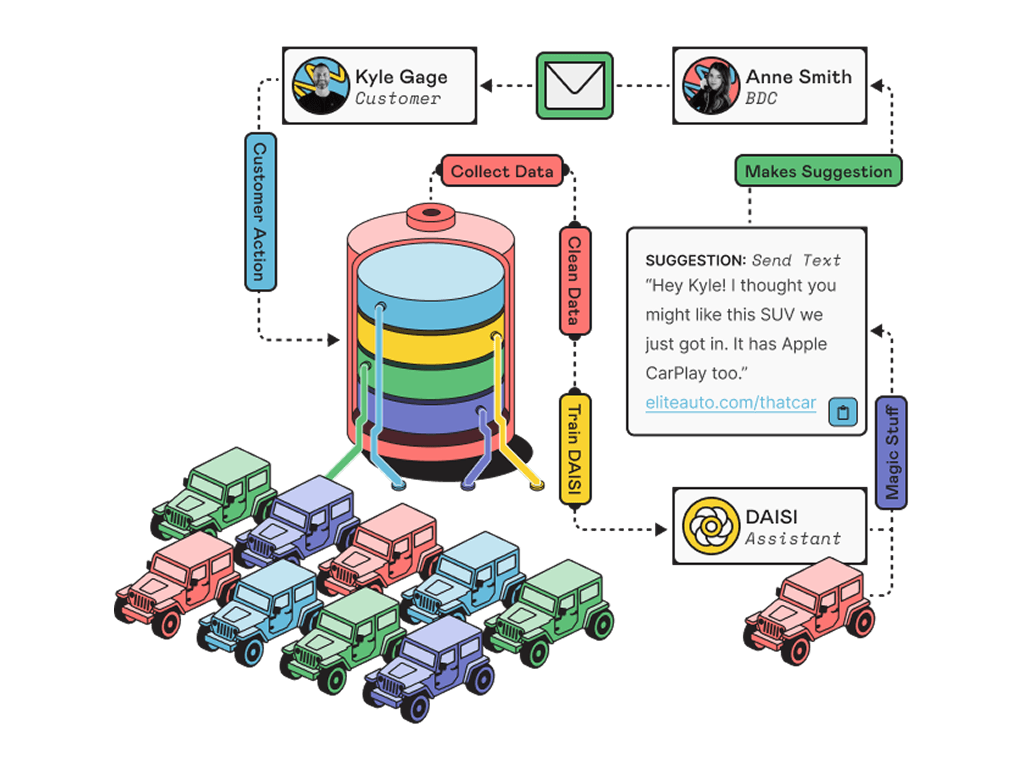
Inventory tools tell you what to buy. That is step one, not the finish line.
This is where I think the conversation gets more interesting.
Inventory intelligence platforms like VINCUE are incredibly valuable because they help answer questions dealers should be asking every day:
What do I need?
What is missing?
What is aging?
What is overpriced?
What is turning fast?
Where are the gaps in my market?
That is powerful.
But let’s not confuse intelligence with execution.
Knowing you need more late-model SUVs under a certain mileage threshold is useful. Knowing which sedans are sitting too long is useful. Seeing pricing misalignment is useful.
Useful is not the same thing as operational.
Useful does not send a message.
Useful does not identify likely sellers in your database.
Useful does not re-engage a customer who almost bought.
Useful does not create an appointment.
Useful does not keep a trade conversation alive for six months.
Useful just sits there, being very informative, until a human has time to care.
And that is exactly where AI Operators enter the picture.
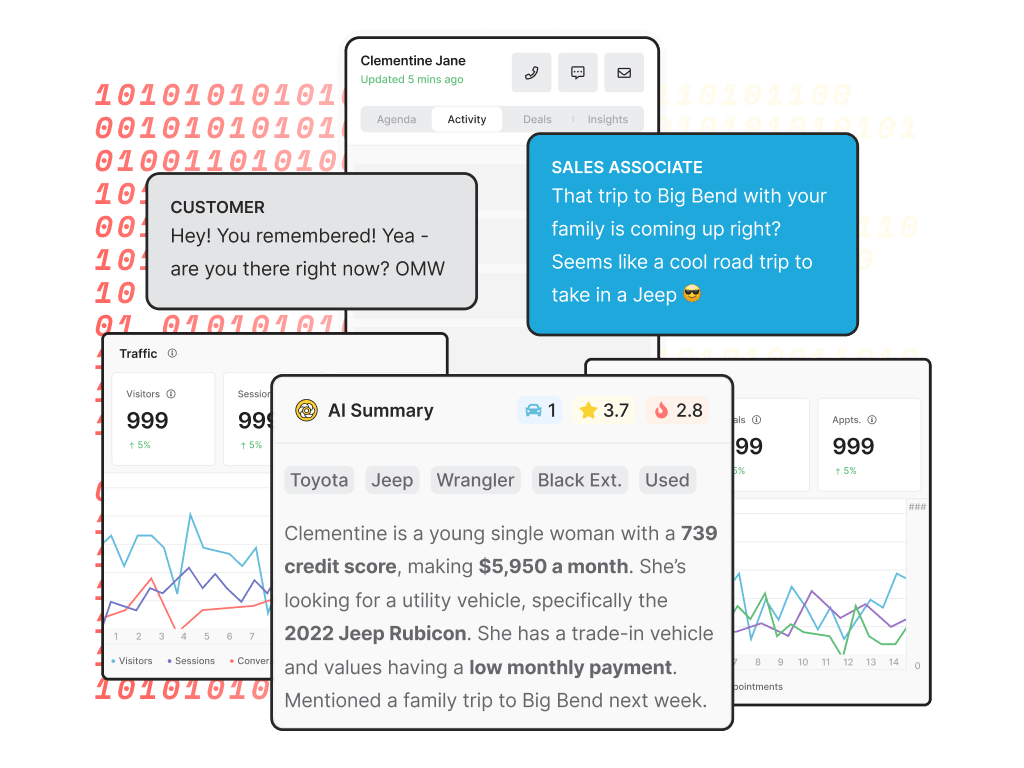
AI Operators are not better dashboards. They are execution layers.
The simplest way I explain this is:
Signal -> Decision -> Action
That is it.
An AI Operator does not just surface a signal. It detects the signal, interprets it, decides what matters, and initiates the next best action.
That matters a lot in acquisition because acquisition is not won by awareness. It is won by speed, relevance, and consistency.
A few examples make this real.
1. Gap-based acquisition
Let’s say your inventory data tells you that you need 2020 to 2022 half-ton trucks under 60,000 miles.
Great. Now what?
In the old world, that insight lands in a meeting.
In the new world, that signal triggers action.
An AI Operator can scan your CRM, sold database, service records, and active shoppers to identify people connected to those vehicles. It can prioritize the best targets, trigger personalized outreach, surface trade values, and tee up upgrade paths.
You did not just identify the gap. You started filling it.
That is a very different operating model.
2. Lost opportunities become acquisition opportunities
A lot of dealers treat lost deals like old lettuce. Once it wilts, toss it.
That is a mistake.
If a customer did not buy because you did not have the right vehicle, the payment did not line up, or the timing was off, there is still a very good chance they own something worth pursuing.
AI Operators can identify those dormant records, segment them based on likely vehicle ownership and timing, and re-engage them with a very different message:
We are looking for vehicles like yours.
Your trade value may have changed.
Here is what your next move could look like.
Now you are not reviving a dead lead. You are opening an acquisition conversation.
That is smarter. And frankly, it is less annoying than generic “just checking in” follow-up from 2009.
3. The service lane becomes a live acquisition channel
This one is not new in concept. It is new in execution.
Every dealer says they want to mine the service drive. Fewer actually do it well. Even fewer do it consistently.
Why? Because consistency is where human-powered processes go to die.
An AI Operator can monitor service appointments, evaluate equity position, account for market demand, and trigger relevant offers automatically. That could mean a trade conversation, an upgrade path, or simply a timely message that says, in plain English, “We want your vehicle.”
Not every RO becomes a deal. That is fine. The point is that every qualifying opportunity gets acted on.
That is what good systems do.
The smartest acquisition strategy might start after the sale
Here is the idea I think more dealers need to internalize:
The best car you will ever acquire is one you already sold.
Why?
Because you know the customer.
You know the vehicle.
You know the history.
You probably know the service story.
And if you are paying attention, you can know when the timing is right before the customer starts shopping around.
This is where lifecycle acquisition gets really interesting.
Imagine a sold customer profile that does not just sit in the CRM collecting dust. Instead, it evolves.
Their mileage changes.
Their equity position changes.
The market demand for their vehicle changes.
Your inventory need changes.
Their likely upgrade path changes.
An AI Operator can keep that relationship open over time with helpful, relevant, non-spammy communication:
Your vehicle is worth more than it was 90 days ago.
We are actively looking for models like yours.
Here is what trading now could look like.
Here is a payment range if you moved into something newer.
Now your acquisition strategy is no longer reactive. It is continuous.
That is how you stop waiting around and hoping the right units magically show up.
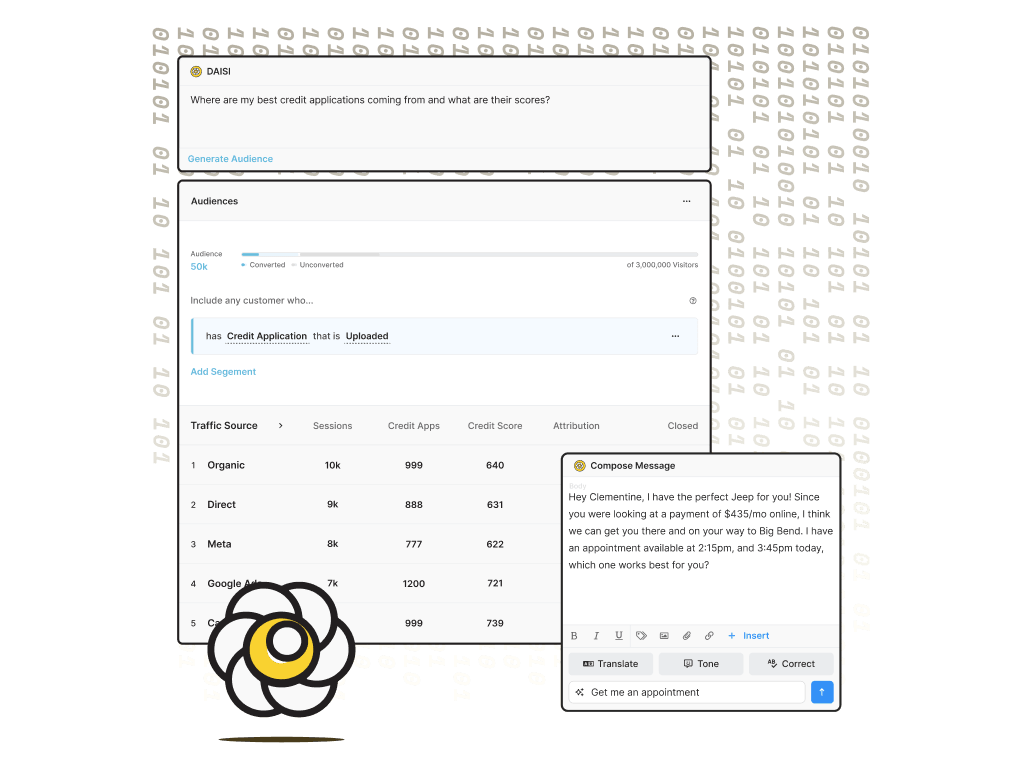
The real opportunity is connected execution
The biggest mistake dealers make with AI is trying to wedge it into one tool and call it transformation.
That is not transformation. That is a feature.
The real shift happens when AI can operate across the stack.
A customer submits a trade form on your website.
That record gets enriched.
The vehicle gets evaluated against your current inventory gaps.
The customer gets prioritized based on acquisition value.
The CRM gets updated.
A personalized message goes out.
A task gets created if human involvement is needed.
Follow-up continues with updated values over time.
That is not “marketing automation.” That is connected execution.
And when it works, the dealership stops behaving like four departments with separate memories and starts acting like one acquisition system.
That is where the advantage is.
People, process, and product still matter
I am a big believer in AI, obviously. But AI does not magically fix bad thinking.
If your messaging is weak, AI will help you send weak messaging faster.
If your process is broken, AI will help you break it at scale.
If your team has no clear rules for what matters, AI will be running around a very confused building.
The stores that win here will be the ones that align three things:
People
Teams that know the goal is not “touching the lead.” The goal is acquiring the right vehicle at the right time.
Process
Clear rules for what signals matter, what actions get triggered, and when humans should step in.
Product
Tools that can actually connect inventory intelligence, customer data, website behavior, and messaging into one operating model.
This is not about replacing people. It is about removing the dead space between seeing an opportunity and acting on it.
There is a lot of dead space in most dealerships.
What dealers should do next
If I were a dealer looking at this shift and wondering where to start, I would do four things immediately.
1. Identify your top five acquisition signals
Not fifty. Five.
Start with the most obvious:
trade form submissions
lost deals with likely owned vehicles
service customers with equity
sold customers in likely replacement windows
inventory gaps with known customer matches
2. Pick one closed-loop use case
Do not try to automate the universe on day one.
Pick one thing and make it work end to end.
Example: If a customer owns a vehicle you need and hits a value-check form, what should happen in the next five minutes, five days, and five weeks?
Build that.
3. Measure speed to action
Dealers obsess over lead response time on the sales side and then casually ignore response time on the acquisition side.
That is silly.
If someone signals interest in selling or trading, speed matters there too.
4. Treat sold customers like future inventory
Because they are.
That one change in mindset alone can materially change the way your store thinks about sourcing.
The dealers who win will not just know what to buy
They will build systems that go out and get it.
That is the shift.
Not more dashboards.
Not more reports.
Not more meetings about the reports.
More execution.
The next era of vehicle acquisition belongs to the dealers who can recognize signals early, decide what matters fast, and act automatically enough that opportunities do not die in a manager’s inbox.
Because at the end of the day, dealers do not lose acquisition opportunities because they lacked data.
They lose them because no one acted in time.
And in this market, the store that acts first usually gets the car.