

DSP/104 · April 16, 2026 · Dealer News · 8 min
Agentic Dealership CRM: How AI Agents Help Sales Teams Sell More Humanely
By Nick Askew

By Nick Askew, Space Auto
Dealerships do not need AI to replace salespeople.
They need AI to give salespeople their day back.
That is the real promise of a CRM with AI agents. Not a glorified chatbot. Not another dashboard. Not more noise. A real agentic dealership CRM should take repetitive, time-consuming work off your team’s plate so your people can spend more time doing the things that actually move deals forward: building trust, solving problems, communicating clearly, sending the video, handling objections, and making decisions with a customer in front of them.
That matters because the future of auto retail is not less human. It is more human, with better software behind the scenes.

What makes an AI agent different from a chatbot?
A lot of people are using the word agent pretty loosely right now. I think that is a mistake.
An AI agent is not just a tool that writes text. IBM defines AI agents as systems that can autonomously perform tasks using workflows and tools, including decision-making, problem-solving, and taking actions. NIST’s new AI Agent Standards Initiative describes agents as AI systems “capable of autonomous actions” that operate securely on behalf of users. That is a very different category from a chatbot that simply answers questions. (IBM)
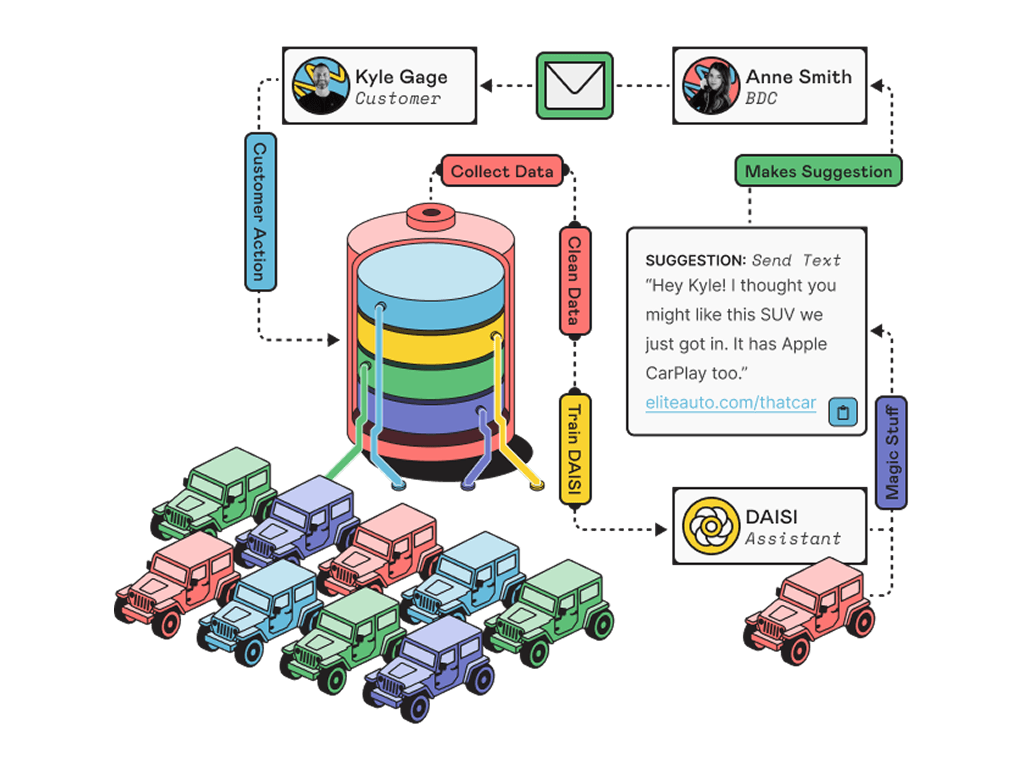
In dealership terms, that means an AI dealership CRM should not stop at suggesting a reply. It should be able to read the conversation history, understand the context, check the schedule, recognize the next safe step, and take a narrow action inside the CRM under clear guardrails. That is what makes a dealership CRM with AI actually useful.
Why this matters now
This is not just hype. Across industries, the biggest near-term value from generative AI is landing exactly where dealerships live every day: customer operations and marketing and sales. McKinsey estimates that about 75% of generative AI’s value falls across customer operations, marketing and sales, software engineering, and R&D, and its retail analysis explicitly includes auto dealerships. In a separate marketing and sales analysis, McKinsey says about a fifth of current sales-team functions could be automated and argues that AI can offload mundane sales work, freeing teams to spend more time with customers while reducing cost to serve. (McKinsey & Company)
That should get every GM, sales manager, and BDC leader’s attention.
Because the average sales department is still asking humans to do a ridiculous amount of low-value work manually: answer the same inbound questions, chase the same no-shows, reschedule appointments, log notes, update outcomes, review unworked leads, build follow-up lists, reconcile duplicates, and hunt through activity history just to figure out what happened.
Those tasks matter. But they should not consume the best hours of your best people.
What the research says outside automotive
The strongest argument for AI agents in dealerships does not come from vendor decks. It comes from what is already happening across other industries.
In a large field study of 5,179 customer support agents, researchers from Stanford and MIT found that AI assistance increased productivity by 14% on average, with a 34% improvement for novice and lower-skilled workers. They also found improvements in customer sentiment, employee retention, and worker learning. That is a big clue for dealerships: AI can help newer reps get better faster while making the customer experience better, not worse. (NBER)
MIT researchers studying professional writing tasks found that access to generative AI cut completion time by 40% and increased output quality by 18%. Again, the point is not that AI replaces the worker. The point is that it removes friction from the work. (MIT News)
At Harvard Business School, researchers working with Boston Consulting Group found that knowledge workers using AI completed 12.2% more tasks, finished them 25.1% faster, and produced significantly better quality on tasks within AI’s capability frontier. But they also found something just as important: on a complex managerial task outside that frontier, AI users were 19% less likely to get the right answer. (Harvard Business School)
That is one of the most important lessons in this entire conversation.
AI is incredibly useful for routine, repeatable, high-frequency work. It is not a substitute for judgment in nuanced situations.
That should sound familiar to anyone running a dealership.
The dealership lesson: let agents do the repeatable work
This is why I believe the best agentic dealership CRM is not built to “replace the BDC” or “automate the sales floor.” That is the wrong framing.
The right framing is this: let AI agents handle the repetitive work that slows the team down, so people can focus on the moments that actually require a person.
That means AI agents should be helping with things like:
immediate responses to common inbound questions
follow-up sequences that do not rely on memory
appointment creation, confirmation, rescheduling, and cancellation
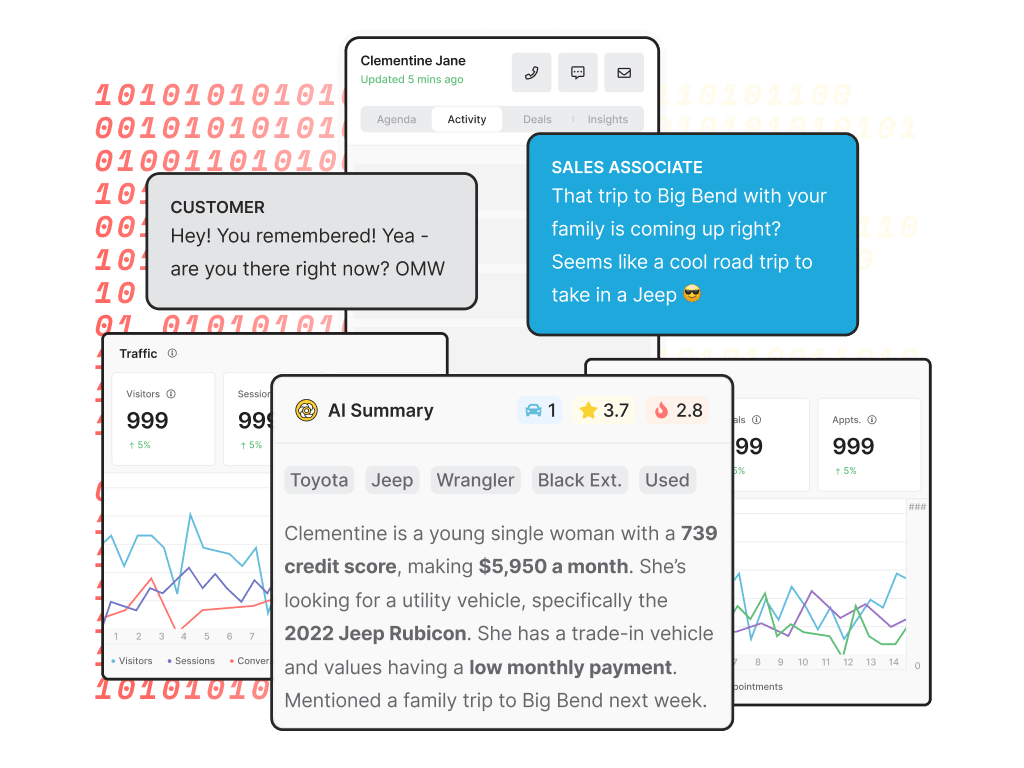
CRM activity logging and conversation summaries
alerting managers to response gaps, no-shows, or unworked leads
pulling together reporting and surfacing the exceptions that actually need attention
That is where a CRM with AI agents starts to create real leverage.
Not because the work disappears, but because the work stops eating the day.
The human work gets more valuable, not less
Here is the part too many people miss: when AI handles the admin, the human side of the dealership becomes more valuable.
McKinsey’s research on middle managers found that surveyed managers spend nearly half their time on nonmanagerial work and nearly one full day each week on administrative tasks. That is not a dealership-specific study, but any dealer operator reading that should recognize the pattern instantly. Too many leaders are buried in reports, approvals, reconciliation, and cleanup instead of coaching people and improving performance. (McKinsey & Company)
Healthcare offers another useful comparison. In a multicenter JAMA Network Open study of ambient AI scribes, burnout among clinicians in ambulatory settings dropped from 51.9% to 38.8% after 30 days. Researchers also found improvements in time documenting after hours and in clinicians’ focused attention on patients. The takeaway is simple: when AI removes administrative burden, professionals can be more present with the human in front of them. (JAMA Network)
That is exactly how dealerships should be thinking about this.
Give the sales team more time for the walkaround. More time for the trade explanation. More time for the delivery. More time for the follow-up video. More time for the customer who is confused, skeptical, excited, or stuck. More time for the stuff that actually builds gross the right way: trust, clarity, speed, and service.
Automotive data says the human moments still matter most
The car business already tells us what customers value.
JD Power’s 2025 U.S. Sales Satisfaction Index says buyer satisfaction is driven most by delivery process, dealer personnel, and working out the deal. The dealership website ranks behind all three. In other words, digital matters, but the people and the deal experience still matter more. The same study found that 22% of buyers wanted a follow-up explanation of vehicle features a few weeks after delivery, but 53% never got one. It also found that when dealers clearly justified trade-in values, satisfaction with the deal-making process averaged 800, versus 672 when no justification was provided. Transparency and follow-up are not soft skills. They are business performance.
JD Power’s 2024 Customer Service Index tells a similar story on the service side. Customers were four times more likely to want service updates by text than by phone call, and advisor satisfaction improved by 31 points when service advisors provided photos or videos rather than just explaining results without them. Technology improves the experience when it makes communication faster, clearer, and more human.
That should shape how dealers think about AI.
The goal is not to make the customer talk to a machine forever. The goal is to use AI to remove delays and busywork so your team has more capacity to deliver the high-trust moments customers actually remember.
So what should an AI BDC dealership actually look like?
To me, the future AI BDC dealership is not a room with fewer people. It is a team with more capacity.
It is a store where inbound questions get answered instantly, but complex questions get handed to a person with the full context ready.
It is a store where appointments are set and cleaned up automatically, but the salesperson still owns the relationship.
It is a store where follow-up does not die because someone got busy.
It is a store where managers do not spend half the morning hunting through records to see who got called and who did not.
It is a store where the CRM is cleaner, the reporting is more reliable, and the team is better prepared before every conversation.
And most importantly, it is a store where humans are not stuck doing robot work.
What dealers should demand from a dealership CRM with AI
Not every “AI-powered” product deserves the label.
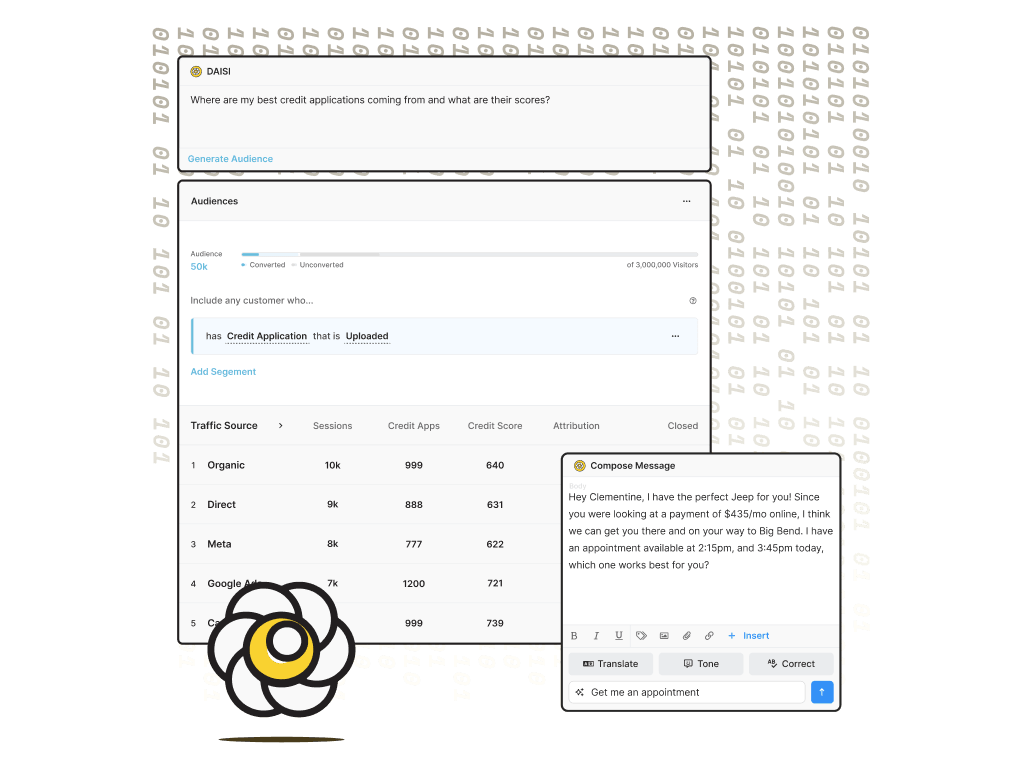
A real dealership CRM with AI should do more than generate a message. It should operate inside the workflow with real context, strong guardrails, clean logging, and clear escalation paths. It should be able to take narrow, safe actions, but it should also know when to stop and hand off to a person.
That matters because the Harvard/BCG research is clear: AI helps inside its frontier and can mislead outside it. The winning model is not uncontrolled automation. It is human-guided, workflow-level automation with accountability. (Harvard Business School)
So if you are evaluating an AI dealership CRM, the real questions are not “Does it have AI?” or “Can it write a text?”
The real questions are:
Can it safely do the repetitive work inside the CRM?
Can it keep the data clean?
Can it help my team move faster without creating chaos?
Can it make my people more available for customers?
Can it improve the customer experience, not just the automation story?
That is the bar.
Final thought
I do not think the future dealership wins by hiding behind more technology.
I think it wins by using better technology to become more human.
That is why I believe in AI agents inside the sales department. Not because I want fewer conversations. Because I want better ones. Not because I want fewer people involved. Because I want the right people spending more time on the right things.
The best agentic dealership CRM will not replace your team.
It will give your team the time to be great.
And in this business, that is still what matters most.
Nick Askew
CEO, Space Auto