

DSP/107 · July 10, 2026 · Release Notes · 14 min
Space App 3.35.0 - Introducing Customers Showroom and Space Score
By Nick Askew

It's True: The CRM agents Can Finally See the Showroom: Introducing Customers Showroom and Space Score
Space Auto’s latest CRM update gives dealership teams two things they rarely get from a traditional CRM: a live view of what is happening inside the store and a clear way to identify which open deals deserve attention next.
The new Customers Showroom tracks who is expected, who has arrived, how each visit is progressing, and what happened before the customer left. Space Score, our intelligent deal-scoring engine, estimates the probability that each open deal will close, explains the strongest reasons behind that score, and shows whether buyer intent is rising or falling.
The release also introduces a more responsive interface and moves important user preferences to the backend, allowing each person’s workspace to follow them across devices.
The release in one sentence: Space Auto now connects digital buyer intent, scheduled appointments, physical arrival, in-store progress, and sales prioritization in one continuous workflow.
What Is Included in This Space Auto CRM Update?
This release introduces four major areas of improvement:
Customers Showroom: A live operating view of today’s appointments, showroom traffic, visit progress, and completed visits.
Space Score: A machine-learning-powered close probability with a tier, reasons, and momentum trend for each eligible open deal.
Responsive CRM navigation: Headers and controls now adapt intelligently across mobile, tablet, and desktop screens.
Cloud-synced user preferences: Filters, list sorts, and DAISI layout settings now follow the user instead of remaining tied to one device.
The result is not another dashboard for people to ignore. It is a clearer operating system for the dealership.

Dealerships Do Not Need More Data. They Need Better Answers.
Most CRMs are good at documenting what already happened.
A lead arrived. Someone sent an email. An appointment was created. A note was added. The deal moved stages.
That history matters, but a sales manager usually needs answers to more immediate questions:
Who is supposed to arrive today?
Who is already here?
How long have they been waiting?
Where is each customer in the sales process?
Which active deals are gaining intent?
Where should a manager intervene right now?
A customer can be physically inside the dealership while the CRM still acts surprised. That is not intelligence. It is a filing cabinet with Wi-Fi.
This gap matters because the vehicle purchase journey has not become purely digital. Cox Automotive found that most purchase journeys still include critical in-store steps and identified waiting or idle time at the dealership as the leading point of friction. Its research also found that buyers moving smoothly from online to offline report a more positive experience and a greater sense of control. (Cox Automotive Inc.)
J.D. Power’s 2025 Sales Satisfaction Index similarly identified delivery, dealership personnel, working out the deal, paperwork, the facility, and the dealership website as the central factors shaping buyer satisfaction. The online experience and the physical dealership experience are not separate journeys. Customers experience one dealership. (JD Power)
Customers Showroom and Space Score were built around that reality.
Customers Showroom: See What Is Happening in the Store Right Now
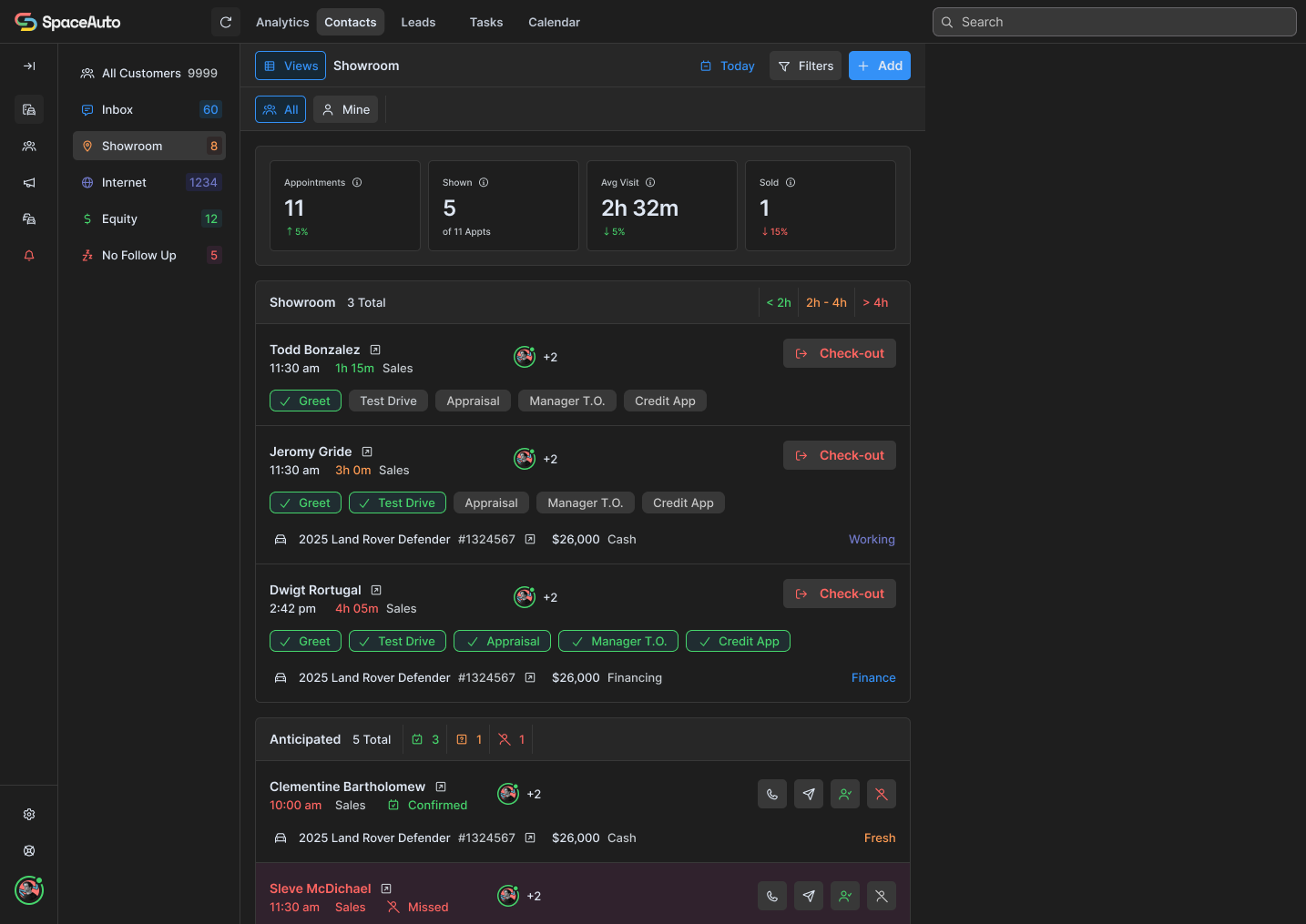
Customers Showroom is a real-time dealership showroom management view inside the Space Auto CRM. It organizes the day’s customer visits into three operational groups: customers currently in the showroom, customers expected to arrive, and customers whose visits have ended.
It lives inside Customers, where dealership teams already work with people and deals. Under the hood, however, the experience centers on appointments and physical visits.
The default view focuses on one day at a time because showroom management is immediate. A manager may review yesterday or prepare for tomorrow, but the central question remains simple:
What needs attention today?
A Priority View, Not a Chronological Dump
The Showroom does not organize its main sections in traditional chronological order.
It places them in order of operational priority:
In Showroom: Customers who are physically present now.
Anticipated: Customers scheduled or expected to arrive.
Completed: Customers whose visits have ended.
That order is deliberate. The customer who has been waiting for 95 minutes matters more right now than the customer who left three hours ago.
This is not a history lesson. It is a control room.
Start With the Numbers That Matter
At the top of Customers Showroom, managers receive an immediate summary of the day:
Total appointments
Number of customers shown
Average visit duration
Vehicles sold
Comparison with the dealership’s recent operating average
These metrics help a general manager or sales manager understand the day before opening an individual record.
Are appointments above or below a normal day? Are customers arriving? Are visits taking longer than usual? Are showroom visits turning into sales?
The manager can then move from the high-level signal to the exact customer or visit that needs attention.
Anticipated: Who Should Be Arriving?
The Anticipated section shows the customers expected at the dealership on the selected date.
Each visit can include:
Appointment time
Customer information
Assigned salesperson
Vehicle year, make, model, stock number, price, and deal status
Confirmation status
Relevant contact actions
A clear control to check the customer in or mark the appointment missed
Confirmed and unconfirmed appointments remain visually distinct. Late customers remain visible until the dealership decides that the appointment has been missed.
Even then, the record remains actionable during the day. A customer who arrives an hour late can still be checked in without forcing the team to rebuild the appointment.
Late customers are not an edge case. They are Tuesday.
In Showroom: Who Is Here, and What Is Happening?
When a customer arrives, a team member checks them in. The visit moves immediately into the In Showroom section.
Space Auto then begins measuring the visit from the customer’s actual arrival time, not the original scheduled appointment time.
That distinction matters. A 10:00 a.m. appointment who arrives at 12:42 p.m. has not been waiting since 10:00 a.m. The system should reflect reality.
Each active visit includes a live timer and the dealership’s road-to-the-sale milestones. A typical configuration may include:
Greeted
Test drive
Appraisal
Manager turnover
Completed
Dealerships can configure these stages around their actual process rather than adapting their process to a rigid software template.
The timer uses clear visual escalation as the visit gets longer. A manager can quickly identify a customer who has been in the store for an unusual amount of time, then look at the completed milestones.
A customer may have been present for more than an hour but still not completed a test drive. Another may have completed the drive and appraisal but never received a manager introduction.
The software does not decide what the manager should do. It makes the missing step difficult to overlook.
Completed: Understand What Happened Before the Customer Left
When a visit ends, the user selects End Visit.
The dealership confirms the actual departure time and adds a required visit note. This protects the record from a common problem: the employee remembers to close the visit 30 minutes after the customer has already left.
The visit then moves into the Completed section with:
Final visit duration
Completed sales milestones
Deal outcome or current status
Departure note
Relevant follow-up actions
A manager can see that one customer spent five hours in the dealership and left to retrieve documentation. Another completed the process and purchased a vehicle. Another left after an appraisal without receiving a turnover.
The visit record now explains what happened. It no longer depends on finding the right person and asking them to reconstruct the afternoon.
Walk-Ins Stop Being Invisible
Customers Showroom also supports customers who arrive without an existing appointment.
A receptionist or salesperson can search for the customer to prevent duplicate records. When a match exists, the existing customer can be selected. When no match exists, a new customer and showroom visit can be created together.
The source can default to walk-in, the current time can become the arrival time, and the employee can record the vehicle or reason for the visit.
The customer then appears in the active showroom view immediately.
This is important because a walk-in should not become CRM data three hours after becoming a real customer.
Customers Showroom: Features, Advantages, and Benefits
Feature | Operational advantage | Dealership benefit |
|---|---|---|
Live anticipated, active, and completed visit sections | Teams see the current state of the floor | Less reliance on meetings, group texts, and verbal updates |
Actual-arrival check-in | Visit timing reflects what truly happened | More accurate wait-time and process reporting |
Live visit timers | Long or stalled visits become visible | Managers can intervene before frustration becomes a lost sale |
Configurable sales milestones | The CRM follows the dealership’s road to the sale | Greater accountability without forcing a generic process |
Required end-of-visit notes | Every completed visit includes context | Better handoffs, follow-up, and coaching |
Walk-in creation with duplicate detection | Unscheduled visitors enter the workflow immediately | Cleaner customer records and fewer missed opportunities |
Daily summary metrics | Leadership sees appointments, shown customers, time, and sales quickly | Faster operational decisions |
Customer and appointment status connection | The digital record reflects physical arrival | One continuous customer history |
Space Score: Know Which Deals Deserve Attention Next
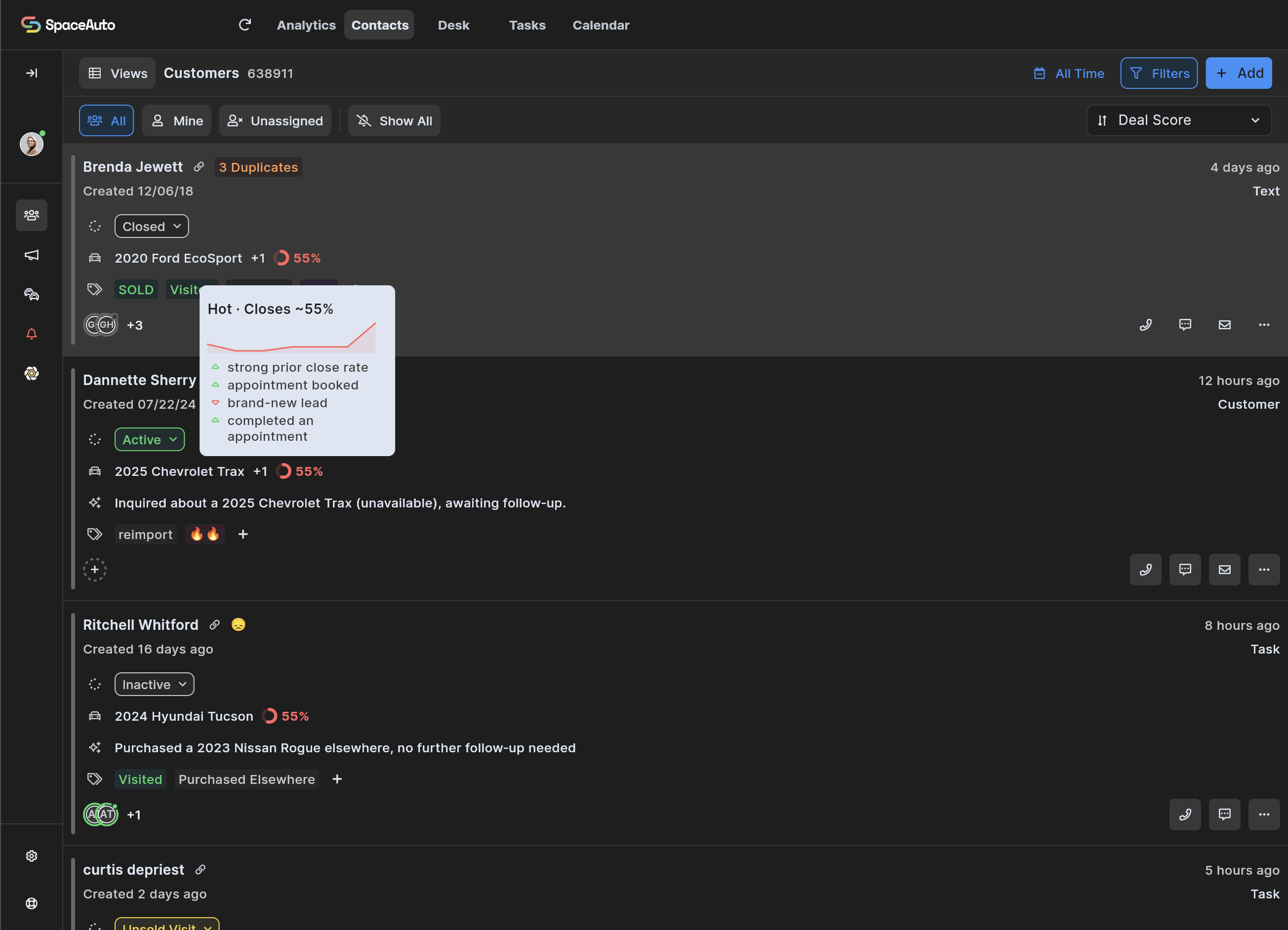
Space Score is Space Auto’s intelligent buyer-intent and deal-prioritization engine. It analyzes the actual history of each eligible open deal and estimates the probability that the deal will close.
For each scored deal, the CRM can surface four useful outputs:
Close probability: A calibrated percentage representing the likelihood of closing.
Deal tier: A clear Hot, Warm, Cool, or Cold classification.
Reasons: Plain-English explanations of the strongest signals affecting the score.
Trend: A daily history showing whether buyer intent is strengthening, holding, or cooling.
This is not a generic number pasted beside a customer’s name. It is an operating signal with context.
Space Score Is Not a Traditional Points System
A traditional rules-based score might assign:
Ten points for opening an email
Twenty points for submitting a credit application
Five points for viewing a vehicle
A fixed deduction after several days of silence
That system may be easy to explain, but the assigned values remain human assumptions. It also treats the same activity the same way across every dealership, customer, vehicle, and stage.
Space Score works differently.
Traditional scoring | Space Score |
|---|---|
🚫 Uses fixed points chosen in advance | ✅ Learns patterns from resolved dealership deals |
🚫 Produces an abstract rank | ✅ Produces a calibrated close probability |
🚫 Often remains static until a rule fires | ✅ Updates after meaningful activity and through daily rescoring |
🚫 Applies one scoring framework broadly | ✅ Adjusts probability calibration around dealership history |
🚫 Provides one number | ✅ Provides probability, tier, reasons, and trend |
🚫 May reward old activity indefinitely | ✅ Uses recency and current behavior as model inputs |
🚫 Can feel like a black box | ✅ Surfaces the strongest positive and negative drivers |
Static points tell a salesperson that one deal scored higher than another.
Space Score is designed to answer a harder question:
How likely is this deal to close, based on what has actually happened so far?
What Information Can Influence Space Score?
The engine evaluates signals already connected to the customer and deal inside Space Auto. Depending on the available history, these can include:
Recent incoming and outgoing communication
Whether and how recently the customer replied
Appointment activity
Progress into desking
Credit application activity
Trade-in information
Vehicle interest and pricing context
Customer website engagement
Task completion
Prior dealership history
Deal age
Changes in activity over time
Intent found in recent conversation language
No single action guarantees a high score.
A credit application may be meaningful, but it matters alongside recency, customer replies, appointment activity, vehicle interest, and the rest of the deal’s history.
Likewise, an old appointment should not keep a silent deal artificially hot forever.
It Uses Machine Learning, Not a Live Language Model
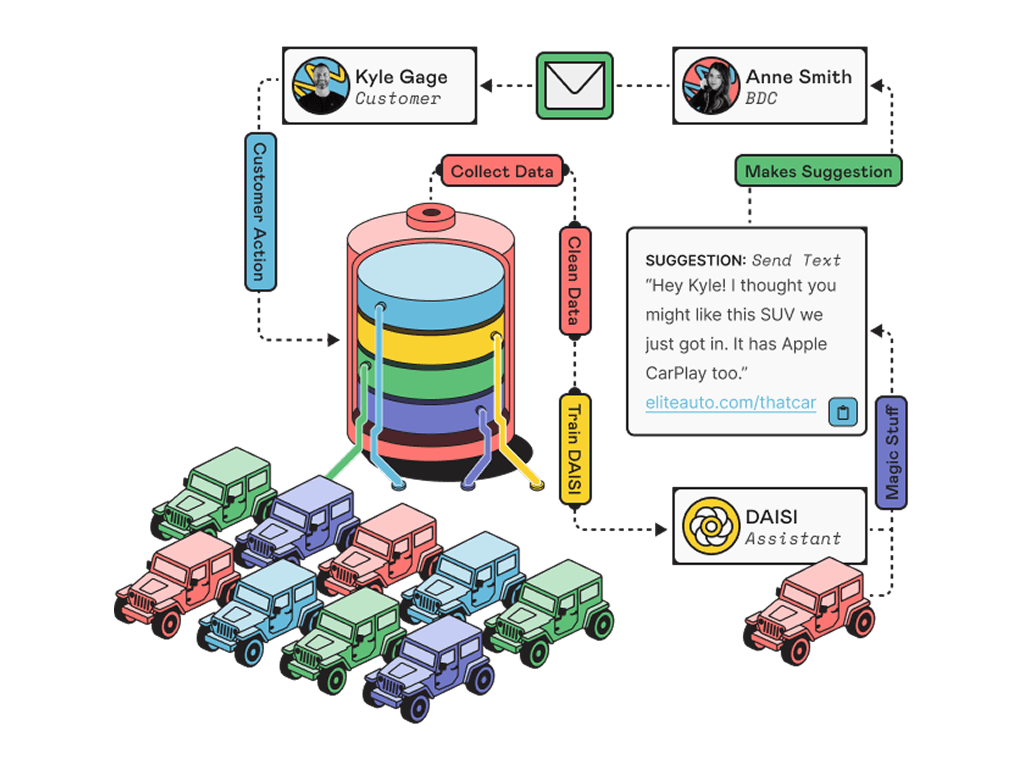
Space Score uses a deterministic machine-learning pipeline. Its core classifier uses CatBoost, an open-source gradient-boosting system based on decision trees. (CatBoost)
A live generative language model is not deciding whether a customer will purchase a vehicle. The system does not ask a chatbot to “guess how serious this person sounds.”
That separation is intentional.
Language can contribute as one structured intent signal, but the final probability comes from a tested classification model evaluating the broader deal history.
Why Calibration Matters
A model can rank deals correctly while still producing misleading percentages.
For example, a model may correctly place the strongest deals at the top but call them “80% likely to close” when only 30% of similar deals actually close.
Space Score applies probability calibration so that the percentage has practical meaning. In a well-calibrated model, deals receiving a probability near 20% should close at approximately that rate across comparable examples.
This is the standard difference between a ranking score and a probability that people can interpret with reasonable confidence. (Scikit-learn)
Space Score also accounts for differences among dealerships. A store with substantial resolved history can rely more heavily on its own observed conversion behavior. A dealership with less history is supported by broader network patterns rather than receiving an unstable probability from a small sample.
The result is not a universal conversion assumption forced onto every store.
Every Score Comes With Reasons
A percentage without an explanation creates a trust problem.
Space Score identifies the model signals pushing a specific deal upward or downward and converts the strongest drivers into direct language, such as:
Customer replied recently
Appointment activity is strong
Credit application submitted
Customer has gone quiet
No recent inbound engagement
Limited signal so far
The underlying method uses feature-level attribution to identify what influenced the individual prediction. SHAP, the framework used for this type of model explanation, assigns importance values to features for a specific prediction rather than providing only a broad, model-wide ranking. (NeurIPS Papers)
The reasons are not generated as improvised sales advice. They come from a controlled vocabulary tied to the model’s actual drivers.
That lets a salesperson understand both what the score is and why it moved.
Buyer Intent Has Direction, Not Just a Current Value
Space Score also stores a daily trend for each deal.
A deal may remain Warm for several days while its probability slowly rises. Another may technically remain Hot while cooling rapidly after the customer stops responding.
Those are not the same situation.
The trend helps teams distinguish:
New momentum
Stable intent
Gradual cooling
A sudden high-value action
A deal that has stopped progressing
This gives managers and salespeople more context than a static badge.
Scores Change When the Deal Changes
Space Score updates in two ways.
Meaningful events can trigger a new score near real time. These include important deal changes, customer-authored communication, appointments, credit applications, trade-ins, and other high-value activity.
The system also re-scores active deals on a daily cadence. That matters because silence does not create an event. Without scheduled rescoring, a deal that goes quiet could remain artificially strong forever.
Space Score does not apply an arbitrary timer that simply subtracts points each day. A deal cools because its current features—engagement, recency, appointment activity, and other signals—have changed.
The Model Is Tested Against Deals It Has Not Seen
Space Score is built to avoid one of the most common problems in predictive systems: allowing information from the future to influence a historical prediction.
Training examples are reconstructed as they would have appeared at specific points in time. The model cannot use a future sale, later appointment completion, post-sale inventory change, or eventual archive event to predict an earlier moment.
A candidate model is also tested against a newer, out-of-time group of deals that it did not see during training. It must pass performance and calibration checks before it can be promoted.
This does not make the model infallible. It makes the evaluation harder to fool.
“Dealerships do not need more data. They need a clear answer to two questions: What is happening in my store right now, and where should my team act next?”
— Nick Askew, CEO of Space Auto
Frequently Asked Questions
What is Customers Showroom in the Space Auto CRM?
Customers Showroom is a live dealership showroom management view that organizes anticipated appointments, active in-store visits, and completed visits for a selected day. It also includes visit timers, sales-process milestones, customer and vehicle details, daily metrics, and visit outcomes.
How does Space Auto show who is currently at the dealership?
A team member checks the customer in when they arrive. Space Auto records the actual arrival time, starts a live visit timer, updates the customer’s showroom status, and places the visit in the In Showroom section.
Can Customers Showroom handle late appointments?
Yes. A late appointment remains visible and can still be checked in. The visit timer begins from the actual check-in time rather than the originally scheduled appointment time.
Can a dealership add walk-ins through the Showroom?
Yes. The user can search for an existing customer to prevent duplicates or create a new customer and showroom appointment together. The walk-in then appears in the active showroom workflow.
What is Space Score?
Space Score is an intelligent deal-scoring feature that estimates the probability that an open deal will close. It also provides a Hot, Warm, Cool, or Cold tier, plain-English reasons behind the score, and a daily momentum trend.
Is Space Score the same as an AI chatbot?
No. Space Score uses a deterministic machine-learning classification model. A live generative language model does not decide the close probability.
What data does Space Score use?
The score can use signals such as recent customer replies, messaging activity, appointments, desking progress, credit applications, trade-ins, website engagement, vehicle details, deal age, task completion, previous customer history, and recent conversation intent.
How often does Space Score update?
Meaningful customer and deal activity can trigger a new score near real time. The platform also re-scores eligible open deals on a daily cadence so deals can cool naturally when engagement declines.
Can users see why a deal received its score?
Yes. Space Score surfaces plain-English reasons representing the strongest model signals that increased or decreased the close probability.
Does Space Score replace the salesperson or sales manager?
No. It helps people prioritize attention and identify changes in buyer behavior. The dealership team still owns the customer relationship, follow-up strategy, and final decisions.
Is Space Score a credit score?
No. Space Score predicts the likelihood that an automotive retail deal will close. It is not a consumer credit score and does not make lending, approval, or financing decisions.
Do Space Auto user settings sync across computers?
Yes. Supported filter preferences, list sorts, and DAISI layout settings are now stored by user on the backend. They persist across logout, application restart, reinstall, and device changes.